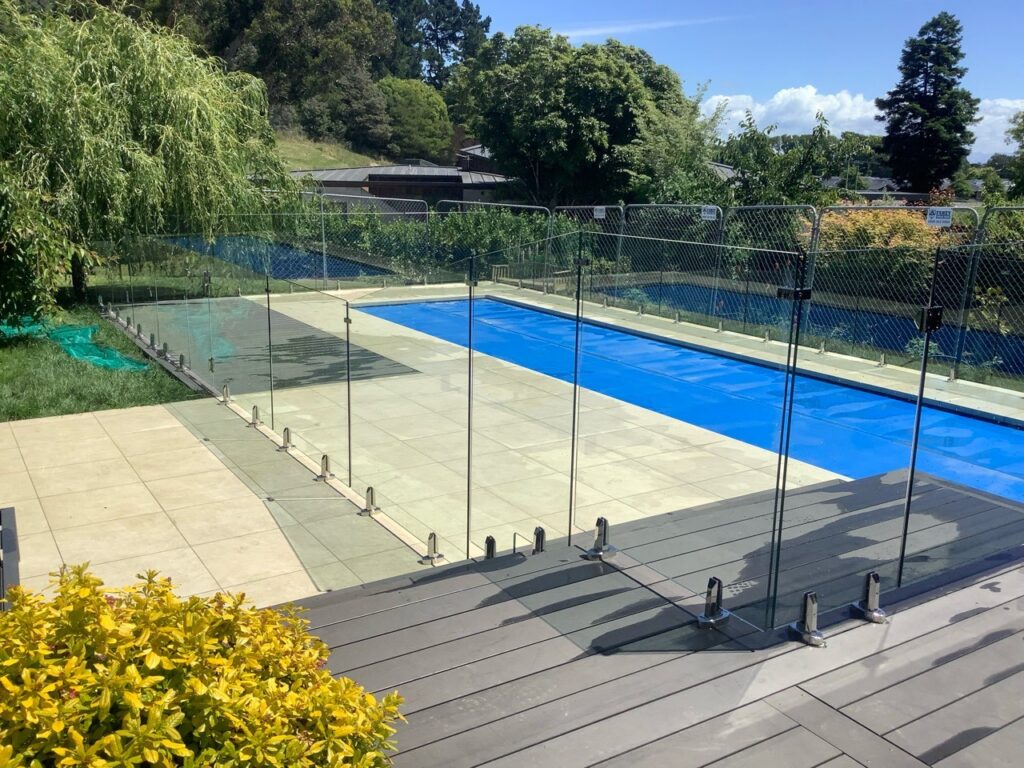


Bermuda Pools is keeping up to date with the latest determinations from the Ministry of Business Innovation & Employment (MBIE) relating to swimming pool barriers and Building Code compliance.
Two recent determinations from MBIE — 2026/001 and 2026/013 — provide useful insight into how pool barriers can be assessed, particularly the importance of considering the barrier as a complete system.
1. MBIE Determination 2026/001 — Pool cover storage box
Date: 7 January 2026
Location: Rolleston, Christchurch
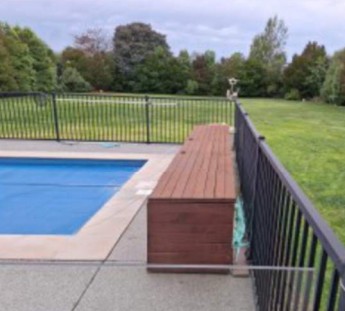
Issue: A pool-cover storage box was permanently positioned inside and close to the pool barrier.
Council: Selwyn District Council.
What happened
The pool was installed in 2016, with a 1.2m-high aluminium/glass barrier. A pool-cover storage box was located 220mm inside the barrier and was approximately 700mm high.
During a later inspection, the council considered that the box could potentially act as a foothold and help a child climb over the barrier. The council issued a Notice to Fix, requiring the owners either to remedy the barrier or drain the pool.
MBIE’s finding
MBIE reversed the Notice to Fix.
The important point was that the pool was constructed in 2016, when FOSPA and F4/AS1 applied. Under section 162C(2)(b), the owners could rely on the Building Code requirements that were in force when the pool was constructed, provided the relevant compliance pathway had been established.
MBIE found that the applicable F4/AS1 requirements dealt with permanent objects outside the barrier. They did not require objects located inside the pool barrier to be assessed in the same way.
MBIE also considered the actual storage box and concluded that, because of its 700mm height and 220mm separation from the barrier, it did not compromise the barrier’s primary function of restricting access by unsupervised children under five.
MBIE concluded that the Notice to Fix was deficient and reversed it.
Practical takeaway:
For existing pools, the compliance requirements applicable when the pool was originally constructed can be extremely important. A council cannot simply require an older pool to be brought up to the current standard where section 162C(2)(b) provides an alternative compliance pathway.
2. MBIE Determination 2026/013 — Boundary fence + glass pool barrier
Date: 7 April 2026
Location: Prebbleton, Christchurch
Issue: Whether a proposed 1.8m timber boundary fence, joined to 1.2m glass pool fencing, complied with F9.
Council: Selwyn District Council.
The proposed design
The pool had:
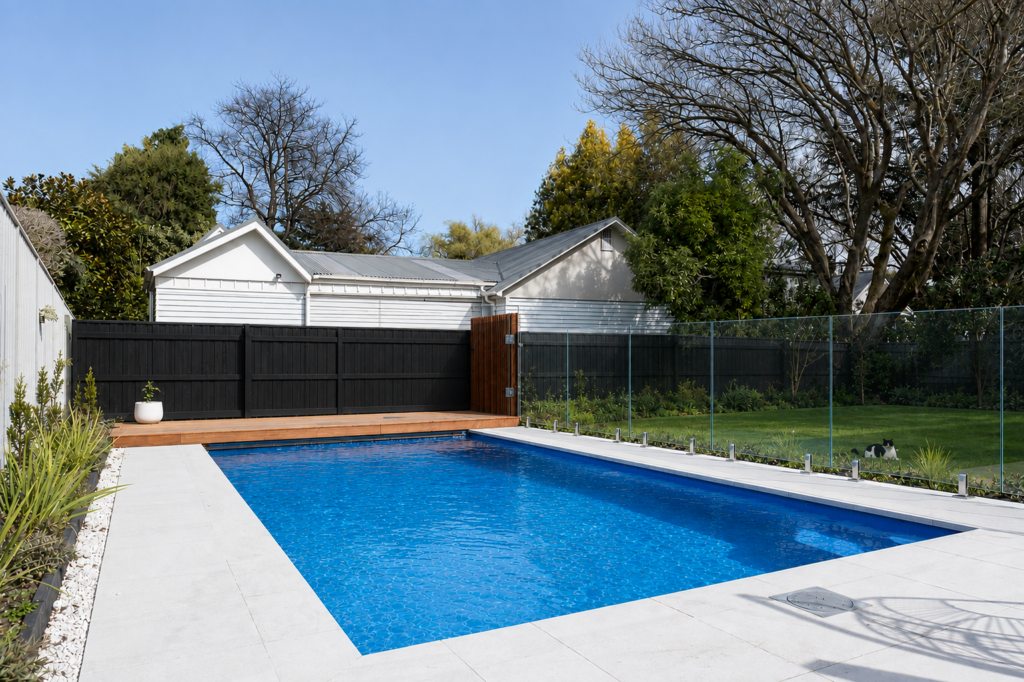
- 1.2m-high glass fencing on three sides; and
- a 1.8m-high timber boundary fence on the fourth side.
Where the glass fencing joined the boundary fence, the top of the glass was approximately 600mm below the top of the 1.8m boundary fence.
The council was concerned that the junction created a projection that could assist a child in climbing over the barrier. It therefore considered that the design did not comply with F9.3.3.
Strict F9/AS1 compliance
MBIE agreed with the council that the design did not comply with F9/AS1.
F9/AS1 requires a 900mm non-climbable zone on the pool side of a boundary barrier. The junction with the lower glass fence created a projection within that zone, meaning the design did not meet the Acceptable Solution.
However, that was not the end of the analysis.
MBIE considered it as an Alternative Solution
The Building Code is performance-based, so a design can comply even where it doesn’t strictly follow an Acceptable Solution.
MBIE looked at the actual risk:
- the boundary fence was 1.8m high;
- the inside face of the timber fence was completely vertical;
- there were no hand or footholds on the inside;
- the glass was only 12mm wide;
- the top of the glass was therefore not considered an inviting or practical foothold;
- there were no other nearby features that would help a child climb down into the pool area.
MBIE concluded that, in combination, these features meant it would be very difficult for a young child to negotiate the barrier.
Final decision
MBIE determined that the design complied with F9 as an Alternative Solution, despite not complying with F9/AS1.
In other words: It failed the Acceptable Solution but passed the Building Code performance requirements.
A key point emerging from these determinations is that compliance isn’t necessarily about assessing individual components in isolation. The overall design, configuration and practical effectiveness of the barrier need to be considered — particularly its ability to prevent unsupervised access by young children.
This is particularly relevant where a barrier doesn’t strictly follow every provision of F9/AS1, but the overall design may still demonstrate compliance with the performance requirements of Clause F9 as an Alternative Solution.
These determinations don’t provide a blanket approval for particular barrier designs. However, they provide valuable guidance for pool manufacturers, designers, builders, installers and councils when assessing non-standard barrier configurations and existing pool installations.
At Bermuda Pools, we believe understanding the intent behind the Building Code — and how a barrier performs in the real world — is an important part of responsible pool design.
You can read more on these MBIE determinations here.