


Independent engineering research by the University of Canterbury Engineering school confirms significant heating efficiency benefits from Bermuda Pools’ unique insulated fibreglass construction.
Background
Bermuda Swimming Pools, manufactured by The Composite Group in Christchurch, incorporate a unique insulation system designed to minimise heat loss and improve swimming pool heating efficiency.
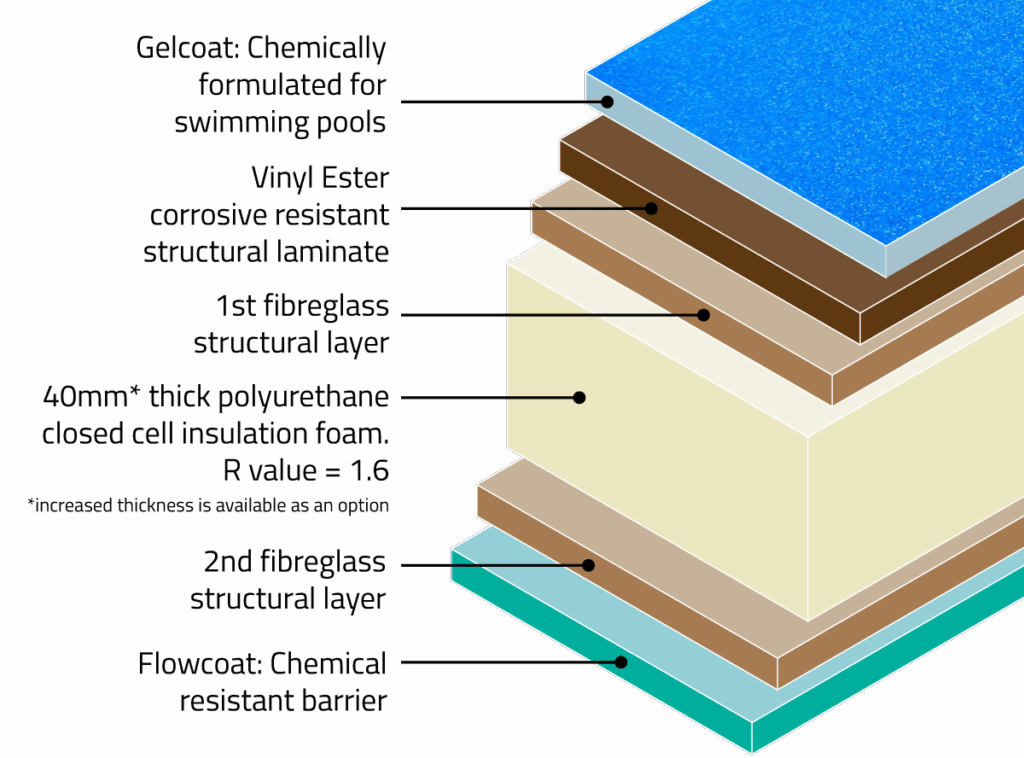
Unlike conventional fibreglass pools, Bermuda pools have an insulation foam layer incorporated into the walls during manufacture, combined with insulated foam sheets as a base. This construction is designed to reduce the amount of heat escaping from the pool water into the surrounding ground.
While the benefits of this insulation have long been understood, The Composite Group wanted to establish exactly how much difference it makes.
In 2026, The Composite Group engaged final-year engineering students from the University of Canterbury to undertake an independent study into the thermal performance of Bermuda swimming pools, comparing them with an equivalent conventional competitor pool.
The objective was to develop a thermal model capable of quantifying the effect of Bermuda’s insulation and determining the potential reduction in pool heating costs.
The Research
The University of Canterbury team developed computer-based thermal models using ANSYS Fluent 2025 R2, an advanced engineering simulation program.
Two swimming pool designs were modelled:
- Bermuda Senator: A 10 m x 4 m fibreglass swimming pool incorporating approximately 47 mm of insulated wall construction.
- Competitor pool: A comparable 10 m x 4 m conventional fibreglass pool, represented by a 10 mm thick shell without the additional insulation.
The models incorporated thermal properties supplied by Bermuda, laboratory testing and published engineering data.
The study concentrated on heat loss through conduction – the transfer of heat through the pool walls and floor into the surrounding ground. This is the specific heat-loss mechanism that Bermuda’s insulation is designed to reduce.
The team also investigated the effect of groundwater movement around the pool, which is a common feature in Christchurch pool installations, and examined how different groundwater flow speeds influence heat loss and the potential financial benefits of insulation.
Key Findings – A Significant Reduction in Heat Loss
The results demonstrated a substantial difference in thermal performance between the two pool designs.
Over the November to April heating period, the model calculated the following average conductive heat losses:
| Bermuda Pool | Competitor Pool | |
| Average heat loss | 394 W | 1,308 W |
| Cost to replace lost heat | $143 | $474 |
The findings demonstrate that Bermuda’s insulation reduces conductive heat loss by approximately 70% compared with the conventional pool model.
In financial terms, the model calculated that replacing the heat lost through conduction would cost:
- Bermuda pool: $143 per heating period.
- Competitor pool: $474 per heating period.
This represents a potential saving of $331 per heating period through reduced conductive heat loss alone.
The competitor pool model required approximately 3.3 times the expenditure to replace conductive heat loss compared with the Bermuda model.
Groundwater – An Additional Advantage
One of the interesting aspects of the research was the investigation into groundwater movement around swimming pools.
Groundwater can influence heat transfer around a pool, with faster-moving groundwater carrying heat away from the surrounding soil more rapidly.
The research modelled several groundwater flow speeds to understand how this affects the thermal performance of both pool designs.
The results showed that as groundwater flow increases, the difference in performance between an insulated Bermuda pool and a conventional pool becomes even more significant.
The calculated additional cost savings for Bermuda, compared with the competitor model, during February were:
| Groundwater flow speed | Additional cost saving |
| 8.7 metres per day | $33 |
| 100 metres per day | $79 |
| 1,000 metres per day | $312 |
At the highest groundwater flow speed modelled, the competitor pool experienced up to approximately 10 times the conductive heat loss of the Bermuda pool.
This is particularly relevant for properties with groundwater movement around the pool, where insulation can provide an even greater advantage.
What This Means for Bermuda Pool Owners
The University of Canterbury study provides independent engineering evidence to support the benefits of Bermuda’s insulated pool construction.
The findings confirm that the insulation incorporated into every Bermuda pool significantly reduces the amount of heat lost through the pool walls and floor.
For pool owners, this means:
- Less heat escaping into the surrounding ground.
- Reduced energy required to replace lost heat.
- Lower associated pool heating costs.
- An additional advantage in locations with moving groundwater.
The research provides a quantified comparison that was previously unavailable, allowing Bermuda to demonstrate the benefits of its construction with measurable engineering results rather than simply making claims about insulation performance.
Christchurch Made. Engineering Backed.
Bermuda Pools has always believed that a better-insulated pool makes sense, particularly in New Zealand’s cooler climate.
This University of Canterbury research now puts measurable results behind that belief.
With approximately 70% less conductive heat loss than the conventional pool model, Bermuda’s insulated construction offers a significant advantage for anyone looking to enjoy a heated swimming pool while keeping ongoing heating costs down.
Bermuda Pools – locally made, intelligently engineered and designed for New Zealand conditions.
Research note: The reported heating cost comparisons relate specifically to conductive heat loss through the pool shell and floor, based on the study’s thermal modelling and assumptions. They do not represent total swimming pool heating costs, which are also influenced by factors such as evaporation, pool covers, wind exposure, ambient temperatures and heating system efficiency, which we expect would be similar for all pool types. Groundwater savings are additional modelled comparisons for February under the specified groundwater flow conditions.